Journal
Decision Ownership Framework for Leaders
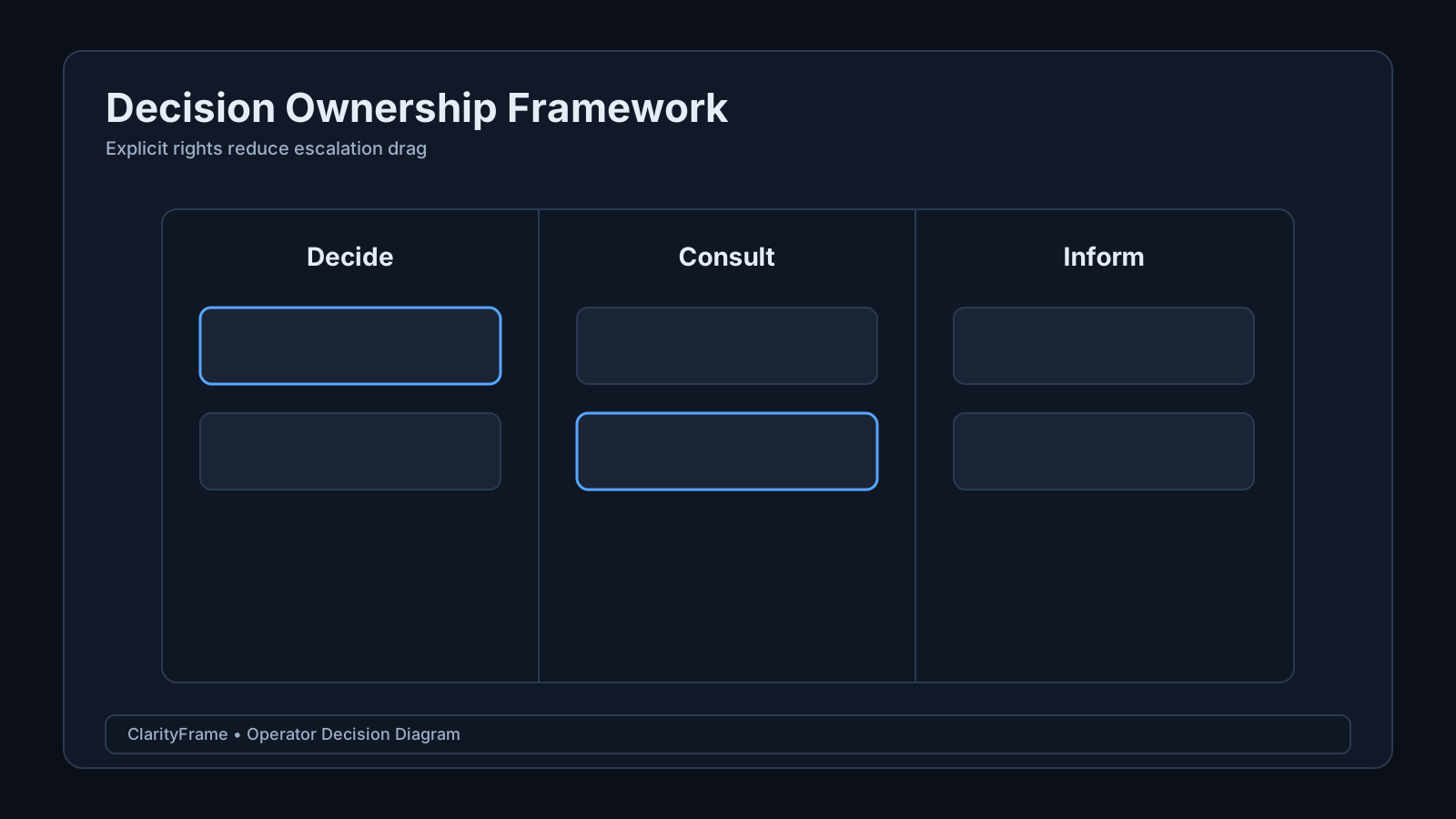
Execution slows when decision ownership is unclear.
People still meet, discuss, and plan, but strategic calls stall because no one knows who has authority to close.
Executive Answer
Leaders should assign decision ownership by domain, risk level, and reversibility before key decisions arise. Clear ownership reduces escalation noise, speeds commitment, and improves accountability. The objective is not centralizing control. It is ensuring every meaningful decision has one explicit owner and one clear closure path.
Summary Framework
- Map decisions by domain and risk level.
- Assign one owner per decision class.
- Define who is consulted versus who decides.
- Publish ownership map across leadership.
- Audit ownership failures monthly.
Definitions
Decision ownership: Explicit authority and accountability for making and closing a decision.
Consulted role: A stakeholder whose input is required but who does not hold final authority.
Escalation drag: Delay caused by unclear authority and repeated upward routing.
Problem Scenario
A product-roadmap decision touches sales, engineering, and finance. Everyone has input, but final ownership is assumed rather than stated.
The decision bounces across meetings. Launch timing slips.
The DOR Map (Decide-Own-Review)
1) Decide map
Catalog recurring decision types (pricing, hiring, roadmap, partnerships, capital allocation).
2) Own map
Assign one role-level owner to each decision type.
3) Review map
Define review path: when owners can act independently and when escalation is mandatory.
Before vs After
Before
Ownership is inferred from title or influence.
Result: unclear authority, slow closure, frequent escalation.
After
Leadership uses DOR map and publishes owner matrix.
Result: faster close rates, fewer escalation loops, clearer accountability.
Diagnostic Checklist
- Is ownership explicit for this decision type?
- Who decides versus who advises?
- What threshold triggers escalation?
- Are owners trained for their risk class?
- How many decisions missed target close date this month?
- Which misses were ownership-related?
Common Mistakes
- Assigning multiple final owners.
- Conflating consultation with decision authority.
- Escalating by habit instead of threshold.
- Changing ownership midstream without notice.
When to Seek External Decision Help
If ownership conflicts persist across senior leaders, a short external reset can establish a neutral ownership architecture quickly.
FAQ
Does clear ownership reduce collaboration?
No. It improves collaboration by separating input from final authority.
Should founders retain ownership of all strategic decisions?
Only those with high downside or identity-level consequences.
How often should ownership maps be updated?
At least quarterly or after major org changes.
What is the biggest ownership anti-pattern?
Multiple people believing they are the final decider.
Can this work in flat organizations?
Yes. Flat structure still needs explicit decision authority.
How do we roll this out quickly?
Start with top recurring high-impact decisions and expand.
Bottom Line
Without ownership, decisions drift.
With ownership, execution accelerates and accountability becomes real.
Substack
Get The Briefs By Email
Operator notes and decision frameworks sent through Substack.
Related Briefs
-
How to Stop Decision Loops in Leadership TeamsA practical model to prevent reopened decisions, repeated debate, and execution drift in leadership teams.
-
When to Replace a Leader: A Decision Framework for FoundersDecide replacement timing using performance trajectory, risk, and transition readiness criteria.
-
Hire vs Contractor vs Agency Decision Model for Revenue-Critical WorkChoose the right staffing model using timeline, control, and execution risk criteria.
-
Big Decision Framework: Why Smart Teams Stall and How to MoveA practical 4-step decision framework to reduce team friction, lock ownership, and execute high-stakes calls with speed and confidence.
-
Decision Cadence Framework: How Teams Make Better Calls WeeklyA practical weekly decision cadence framework to reduce strategic drama, lock ownership, and improve execution quality under pressure.