Journal
Founder Decision Fatigue Framework: Protect Judgment Under Load
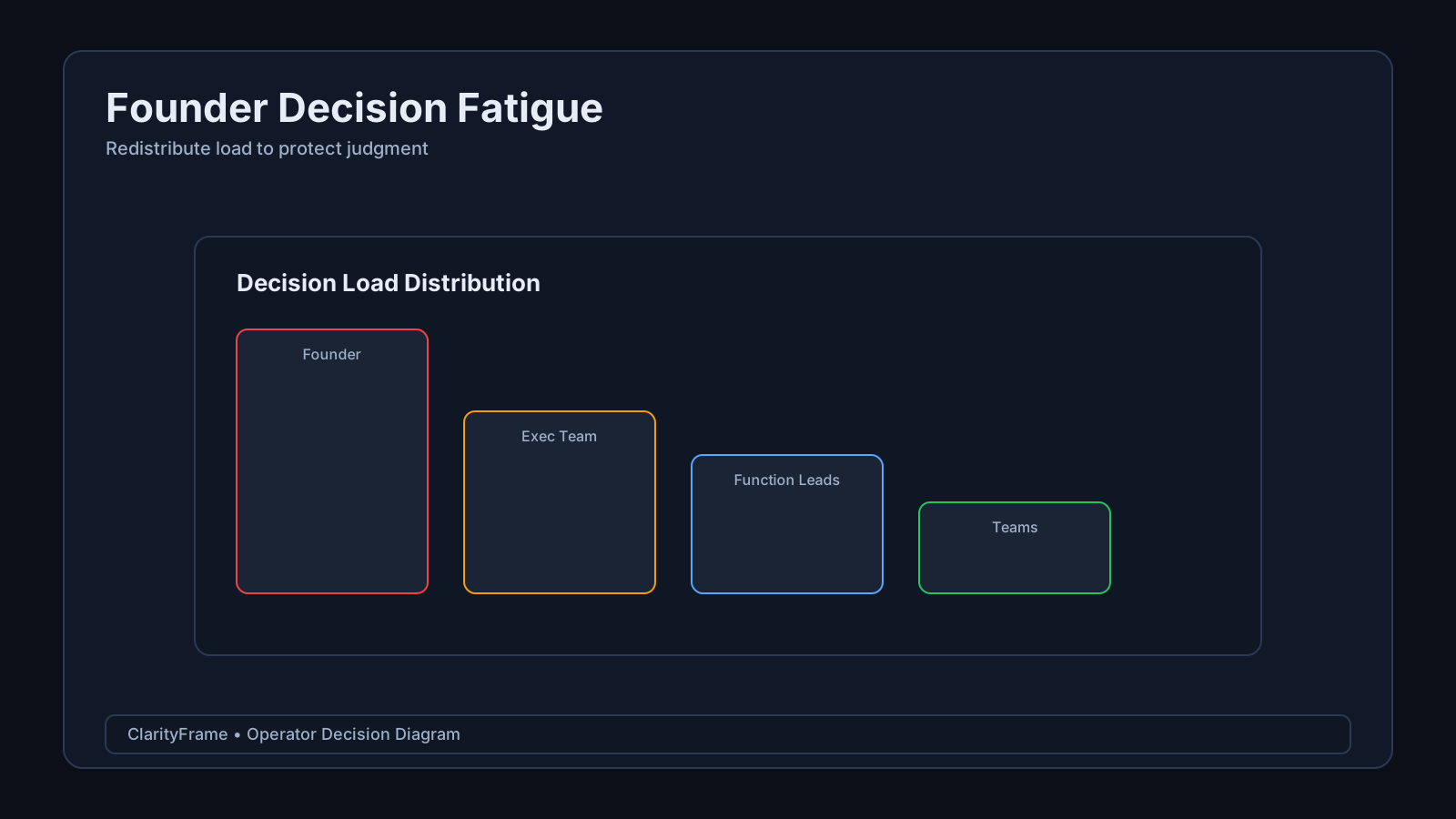
Founder decision fatigue is usually an operating design problem, not a stamina problem. The fix is not better discipline alone. It is reducing low-leverage decisions, clarifying decision rights, and protecting founder attention for the hard-to-reverse calls that shape company trajectory. When that architecture is missing, judgment quality falls even if the founder is technically still functioning.
Summary Framework
- Separate irreversible decisions from reversible ones.
- Keep founder attention on trajectory-shaping calls.
- Delegate bounded decisions with explicit rights.
- Set close dates for every open strategic call.
- Review decision quality weekly.
Definitions
- Founder decision fatigue: The decline in decision quality caused by unresolved tradeoffs, constant escalation, and overloaded decision ownership.
- Decision rights: The explicit rule for who decides, who is consulted, and who is merely informed.
- Trajectory-shaping decision: A call that meaningfully alters company direction, capital risk, market position, or leadership structure.
- Open loop: A decision that remains mentally active because it lacks a clear owner, deadline, or close condition.
- Delegation boundary: The line between decisions the founder must keep and decisions other owners should close independently.
What is founder decision fatigue?
Founder decision fatigue is the cumulative drop in judgment quality that happens when too many active decisions route through one person. It often looks like slower commitment, inconsistent reasoning, or getting pulled into low-leverage approvals while larger calls stay open.
This is why the problem feels personal but behaves structurally. The founder is tired, but the company design is what keeps producing the fatigue.
Why does decision fatigue compound so quickly?
Open loops consume cognitive space even when no work is happening. A founder can carry pricing questions, hiring calls, roadmap disputes, and partnership decisions at the same time, even if none are moving.
That load compounds because:
- unresolved decisions keep resurfacing
- delegation rules are vague
- escalation becomes the default
- low-leverage noise crowds out high-leverage judgment
If the broader team is also looping, Why Smart Teams Stall on Big Decisions covers the team-level version of the same failure.
Which decisions should stay with the founder?
The founder should keep the decisions that are hard to reverse and materially shape company trajectory.
Examples include:
- pricing architecture changes
- market position shifts
- key leadership hires or removals
- strategic partnerships with long lock-in
- major capital allocation moves
Everything else should be delegated with clear rules, not with vague optimism that “the team will figure it out.”
How do you build a delegation model that protects judgment?
Use three buckets.
1. Founder-decide
These are irreversible, identity-shaping, or high-downside decisions. The founder may consult broadly, but still owns the final call.
2. Owner-decide, founder-informed
These are cross-functional calls where the founder needs visibility, but not final control. The founder stays informed to catch strategic drift, not to approve every move.
3. Owner-decide, founder-notified
These are reversible, bounded operating decisions. They should not route through the founder unless downside expands or the team lacks the authority to execute.
This model reduces fatigue because it changes how decisions flow, not just how the founder manages stress.
For the ownership side of that system, Decision Ownership Framework for Leaders is the related brief.
How should founders review open decisions each week?
Run a short weekly review and classify each open decision by:
- reversibility
- downside risk
- strategic impact
- current owner
- close date
If a decision has no owner or no deadline, it is not actually moving. If a low-value decision keeps escalating to the founder, the delegation boundary is broken.
What are the most common mistakes in founder decision design?
- Founder approves too many low-leverage choices.
- Delegation happens without explicit decision rights.
- High-impact decisions stay open with no close date.
- Teams escalate noise because escalation rules are unclear.
- Leaders confuse visibility with control.
When should you not use this framework?
- Extremely early teams with only one or two active strategic calls.
- Acute incidents where immediate containment matters more than process design.
- Short transition windows during reorgs where decision rights are temporarily unstable.
Example scenario: how does a founder reduce decision fatigue without losing control?
A founder is personally involved in pricing experiments, hiring approvals, roadmap sequencing, and partnership terms. Decision latency rises across all four lanes, and the founder starts changing rationale from week to week.
Using the three-bucket model, pricing architecture and partnership terms remain founder-owned, while roadmap sequencing moves to product leadership and routine hiring decisions shift to the functional leader.
Decision statement: redesign decision flow without losing strategic control.
Criteria: reversibility, downside, founder attention cost, and cross-functional impact.
Outcome: the founder keeps fewer, higher-leverage decisions and clears the backlog.
Alternate option that loses: keeping involvement in every meaningful call “for quality control,” because that preserves the illusion of control while degrading judgment on the decisions that matter most.
Success signal: high-impact decisions close on schedule without founder backlog.
Correction trigger: if strategic calls stall for two consecutive weeks or low-value escalations return, tighten the decision-rights map again.
FAQ
What is founder decision fatigue?
Founder decision fatigue is the decline in judgment quality caused by overloaded decision ownership and too many unresolved loops. It is usually a systems issue more than a personal endurance issue.
How do founders reduce decision fatigue?
They reduce it by keeping only high-impact, low-reversibility decisions and delegating the rest with explicit decision rights. The goal is to protect judgment, not to avoid hard work.
Which decisions should always stay with the founder?
The founder should usually keep decisions that shape company trajectory, capital risk, market position, or leadership structure. Those are the calls where weak judgment has the highest downstream cost.
Why does delegation sometimes make decision fatigue worse?
Delegation makes it worse when the boundaries are vague. The founder still gets pulled in, but now later in the process and under more time pressure than before.
How often should a founder review open strategic decisions?
Weekly is usually enough. That review should be short, but it must force classification, ownership, and close dates so open loops do not accumulate quietly.
Is decision fatigue just burnout by another name?
No. Burnout is broader. Decision fatigue is specifically about declining judgment quality under unresolved cognitive load. A founder can be energized and still make poor decisions if the decision architecture is broken.
Bottom line
Founder clarity is not about staying involved everywhere. It is about making fewer, better decisions where they matter most.
When decision flow is designed intentionally, execution speeds up and judgment quality improves. If you need to reset that architecture quickly, use Clarity Sprint.
Substack
Get The Briefs By Email
Operator notes and decision frameworks sent through Substack.
Related Briefs
-
Founder Decision Framework: Why Clarity Matters Even With Strong AdvisorsAdvisors expand optionality. This founder decision framework helps compress options into clear final decisions and execution ownership.
-
When DIY Frameworks Fail: How to Know You Need a Thinking PartnerRecognize when the problem is framing, not information, and when a structured outside session will close the decision faster.
-
High-Stakes Decision-Making Framework for FoundersA practical framework to define the decision, set criteria, compare options, and commit to execution with clarity.
-
Equity vs Salary: Compensation Decision Framework for Early HiresStructure early-hire compensation with consistent equity bands, runway-aware cash offers, and realistic risk tolerance.
-
Clarity Sprint vs Ignite Framework: How to Choose the Right SessionUse a 4-step framework to choose between Clarity Sprint and Clarity Ignite based on complexity, downside, and reversibility.