Journal
Go-to-Market Model Decision Framework: PLG vs Sales-Led vs Channel
Executive answer
Pick a GTM model by starting with how your buyer buys, not how your team prefers to sell. Most failures come from sequencing two weak motions at once.
Summary framework
- Anchor GTM model selection on buyer behavior.
- Assess self-serve readiness before assuming PLG works.
- Map sales complexity to deal size.
- Evaluate channel only when direct capacity is constrained.
- Prove one model before layering a second.
Most GTM failures are sequencing failures. Teams try to run PLG and sales-led simultaneously without the infrastructure to make either one efficient.
The same sequencing problem shows up in Choosing a Target Customer Segment and Market Entry Timing Decision Framework: Launch Now or Wait?: the team wants parallel answers before the first one is proven.
Definitions
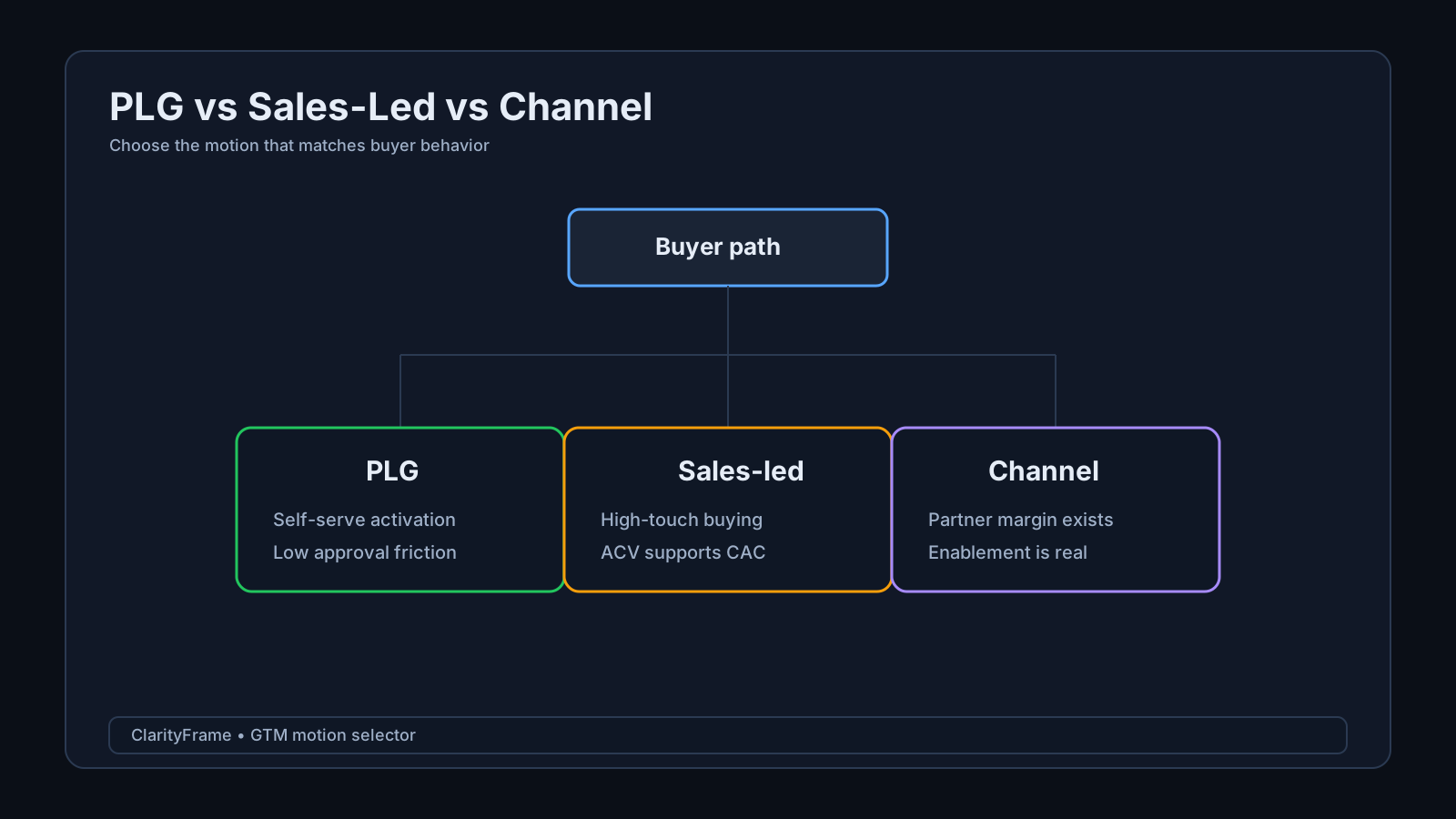
- PLG: A model where the product drives acquisition, activation, and expansion through self-serve use.
- Sales-led: A model where human relationships and structured pipeline management drive deals.
- Channel-led: A model where third parties carry part of the selling motion.
- Hybrid motion: A combined GTM model that only makes sense after one primary motion already works.
What causes GTM model confusion?
Three patterns are common:
- Teams choose PLG because it sounds efficient, not because the buyer can self-serve.
- Sales teams get hired before ICP validation is real.
- Channel gets treated as a shortcut before direct motion has working economics.
A 4-step GTM model decision framework
1) Map buyer behavior
How does the buyer find, evaluate, approve, and purchase? Buyers with procurement and multi-stakeholder approval rarely behave like PLG customers.
2) Test product self-serve readiness
Can the user reach meaningful value without a conversation? If onboarding still requires explanation, PLG will underperform even if signup volume looks healthy.
3) Calculate deal size versus sales cost threshold
If ACV is too low, a sales-led motion can become structurally inefficient. If ACV is high and the buyer needs a conversation, sales is usually the right starting point.
4) Sequence before layering
Pick the primary motion, prove it, then layer the second. Running two incomplete models at once usually gives you one mediocre funnel and one expensive team.
This is also why How to Prioritize Competing Initiatives matters here. GTM model selection is resource allocation wearing a growth label.
Example scenario
A B2B SaaS founder is deciding whether to build a PLG funnel or hire two account executives.
- Decision statement: Which GTM model gets to the first $1M ARR most efficiently?
- Criteria: Buyer behavior, activation without human help, ACV, team cost.
- Outcome: Sales-led wins because the ICP is high-touch and ACV is above $15K.
- Execution: Two AE hires, one ICP, one 90-day pipeline target.
Diagnostic questions before you decide
- Can the target buyer activate without a conversation?
- Does ACV support a sales motion?
- Have you tested activation without human assistance?
- Can your team actually support channel enablement?
- Are you copying a GTM model from a different buyer profile?
FAQ
What is the difference between PLG and sales-led growth?
PLG uses the product as the primary acquisition engine. Sales-led uses people, pipeline, and structured deal management.
When should a startup use PLG?
Use PLG when the user can self-serve, time-to-value is short, and approval friction is low.
How do you decide between PLG and sales-led growth?
Start with buyer behavior. Then test whether the product can activate without human help.
Can you run PLG and sales-led at the same time?
Yes, but usually only after one motion already has proven economics and clear operational ownership.
What ACV supports a sales-led GTM model?
There is no universal line, but many B2B teams need ACV around $10K or more to support a true sales motion cleanly.
Bottom line
GTM model selection compounds over 12 to 24 months. The wrong model is fixable. Spending 18 months executing the wrong one poorly is the real cost.
If Sales, Product, and the founder are each optimizing for a different definition of growth, this is a strong Clarity Sprint candidate.
Substack
Get The Briefs By Email
Operator notes and decision frameworks sent through Substack.
Related Briefs
-
How to Choose a Target Customer Segment: A Revenue-First FrameworkSelect one target segment using pain urgency, access friction, and unit economics.
-
When to Raise Funding: A Founder Decision FrameworkDecide whether to raise now by testing runway, dilution, timing, and the no-raise path before entering a live process.
-
Acqui-Hire vs Shut Down vs Raise: An Exit Decision Framework for FoundersEvaluate acqui-hire, shutdown, or extension raise paths before runway removes the ability to execute any option cleanly.
-
Pricing Model Choice Framework: Subscription vs Usage vs One-TimeChoose the right pricing model with a framework tied to value capture, predictability, and volatility.
-
When to Kill a Project or Pivot: A Founder FrameworkA practical framework for founders to decide whether to kill, pivot, or continue an initiative without losing another quarter.