Journal
High-Stakes Decisions Under Time Pressure: A Founder Playbook
Time pressure distorts judgment.
Founders under deadline often overcorrect in one of two directions: reactive speed without structure, or analysis paralysis disguised as prudence.
Executive Answer
For high-stakes decisions under time pressure, founders should compress scope, protect decision quality with minimum viable rigor, and define immediate execution ownership. The key is not maximal analysis. It is making the best available call within the real time window while preserving optional correction if signal shifts.
Summary Framework
- Define the decision boundary in one sentence.
- Establish minimum viable rigor for the time window.
- Prioritize downside containment over narrative certainty.
- Commit with explicit owner and first 72-hour actions.
- Set a near-term correction checkpoint.
Definitions
Time-pressure decision: A strategic call constrained by a narrow window where delay materially increases downside.
Minimum viable rigor: The smallest analysis set required to make a defensible decision.
Correction checkpoint: A scheduled near-term review to validate or adjust the decision.
Problem Scenario
A founder has 72 hours to decide whether to accept a partnership term that accelerates distribution but creates platform dependency.
If delayed, the deal expires. If rushed, long-term strategic leverage may weaken.
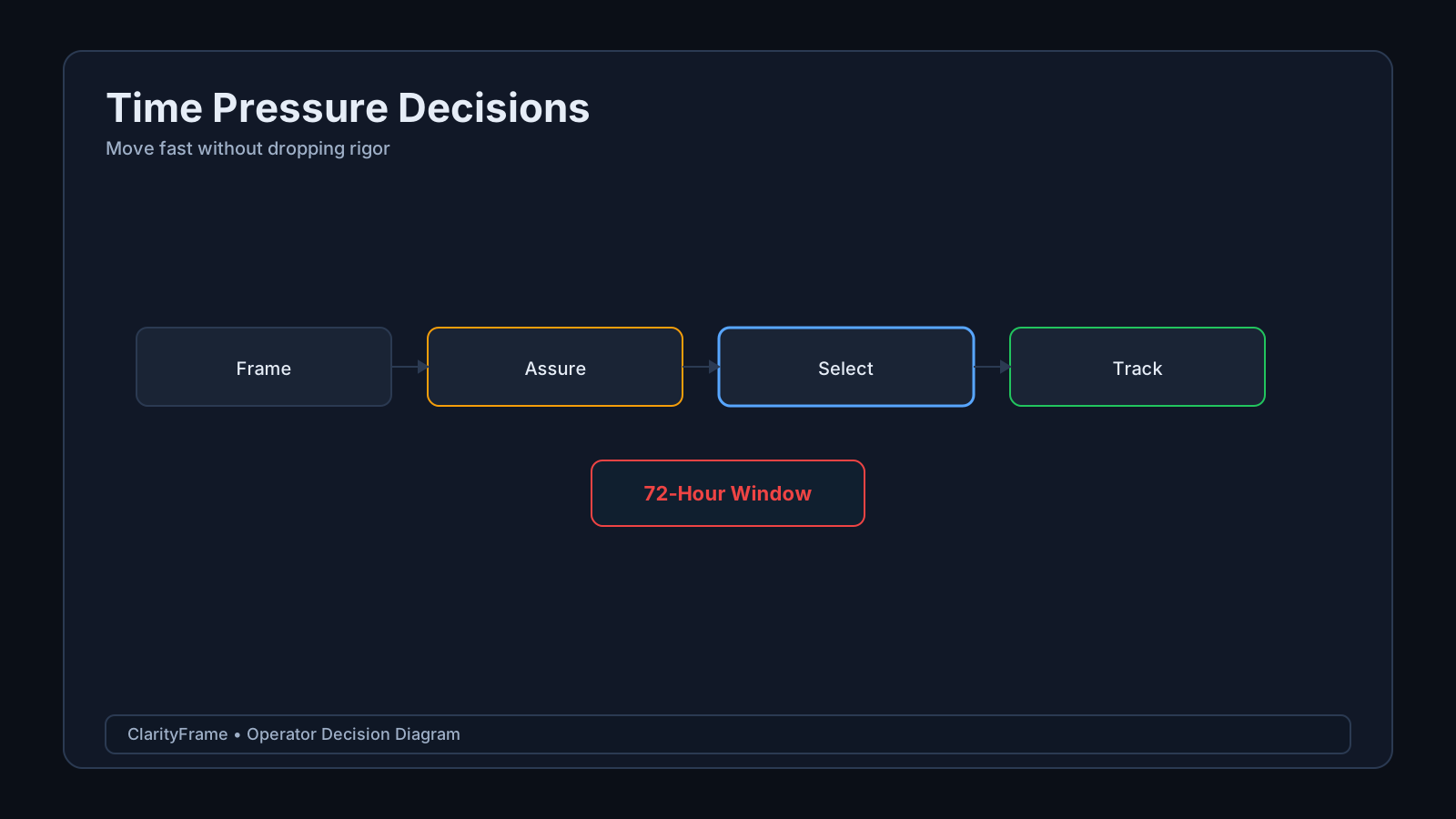
The FAST Pressure Protocol
1) Frame
Define exactly what is being decided and what is not.
2) Assure
Set minimum viable rigor: essential facts, key assumptions, worst downside.
3) Select
Choose the best option for this time window, not ideal future conditions.
4) Track
Assign execution owner and schedule correction checkpoint within days, not weeks.
Before vs After
Before
Founder requests full diligence despite hard deadline.
Result: window closes; team loses optionality through delay.
After
Founder applies FAST protocol with minimum viable rigor and 7-day checkpoint.
Result: timely commitment, controlled downside, and preserved adaptability.
Diagnostic Checklist
- What decision must close before the window ends?
- What minimum facts are non-negotiable right now?
- What is worst plausible downside if wrong?
- Which risks can be monitored post-commitment?
- Who owns execution in first 72 hours?
- When is the first correction checkpoint?
Common Mistakes
- Expanding scope under deadline stress.
- Treating urgency as a reason to skip downside mapping.
- Waiting for certainty that the clock does not allow.
- Failing to assign immediate execution ownership.
When to Seek External Decision Help
If pressure is extreme and internal debate is consuming the window, a focused external session can compress analysis and force a timely, defensible call.
FAQ
Is speed always the priority under pressure?
No. The priority is decision quality within the actual window.
What is minimum viable rigor in practice?
Essential facts, core assumptions, downside map, and owner accountability.
How short should correction checkpoints be?
As short as needed to detect critical failure signals early, often within 3-14 days.
Can this work for irreversible decisions?
Yes, but irreversible decisions require higher minimum rigor even under pressure.
How do I reduce panic behavior in teams?
Use a defined protocol and role clarity before discussion begins.
What if stakeholders demand more analysis?
Time-box additional analysis to what materially changes downside or reversibility.
Bottom Line
Under pressure, discipline beats intensity.
Compress scope, protect rigor, and move with explicit ownership.
Substack
Get The Briefs By Email
Operator notes and decision frameworks sent through Substack.
Related Briefs
-
Crisis Decision Framework: How to Triage Company-Threatening EventsHandle company-threatening events by stabilizing first, assigning single owners, and sequencing decisions by urgency.
-
When DIY Frameworks Fail: How to Know You Need a Thinking PartnerRecognize when the problem is framing, not information, and when a structured outside session will close the decision faster.
-
High-Stakes Decision-Making Framework for FoundersA practical framework to define the decision, set criteria, compare options, and commit to execution with clarity.
-
Partnership Decision Framework: When to Co-Sell, Integrate, or Stay SoloEvaluate partnerships by objective, incentive alignment, activation thresholds, and exit criteria before signing anything.
-
Making Decisions With Incomplete Data: A Founder Confidence ModelHow founders can make high-quality strategic decisions when data is incomplete, conflicting, or delayed.