Journal
How to Prioritize Competing Initiatives Without Political Drift
Most priority failures are not caused by bad ideas. They are caused by too many good ideas competing for the same constrained resources.
Without a clear prioritization rule, teams default to the loudest voice, nearest deadline, or biggest internal sponsor.
Executive Answer
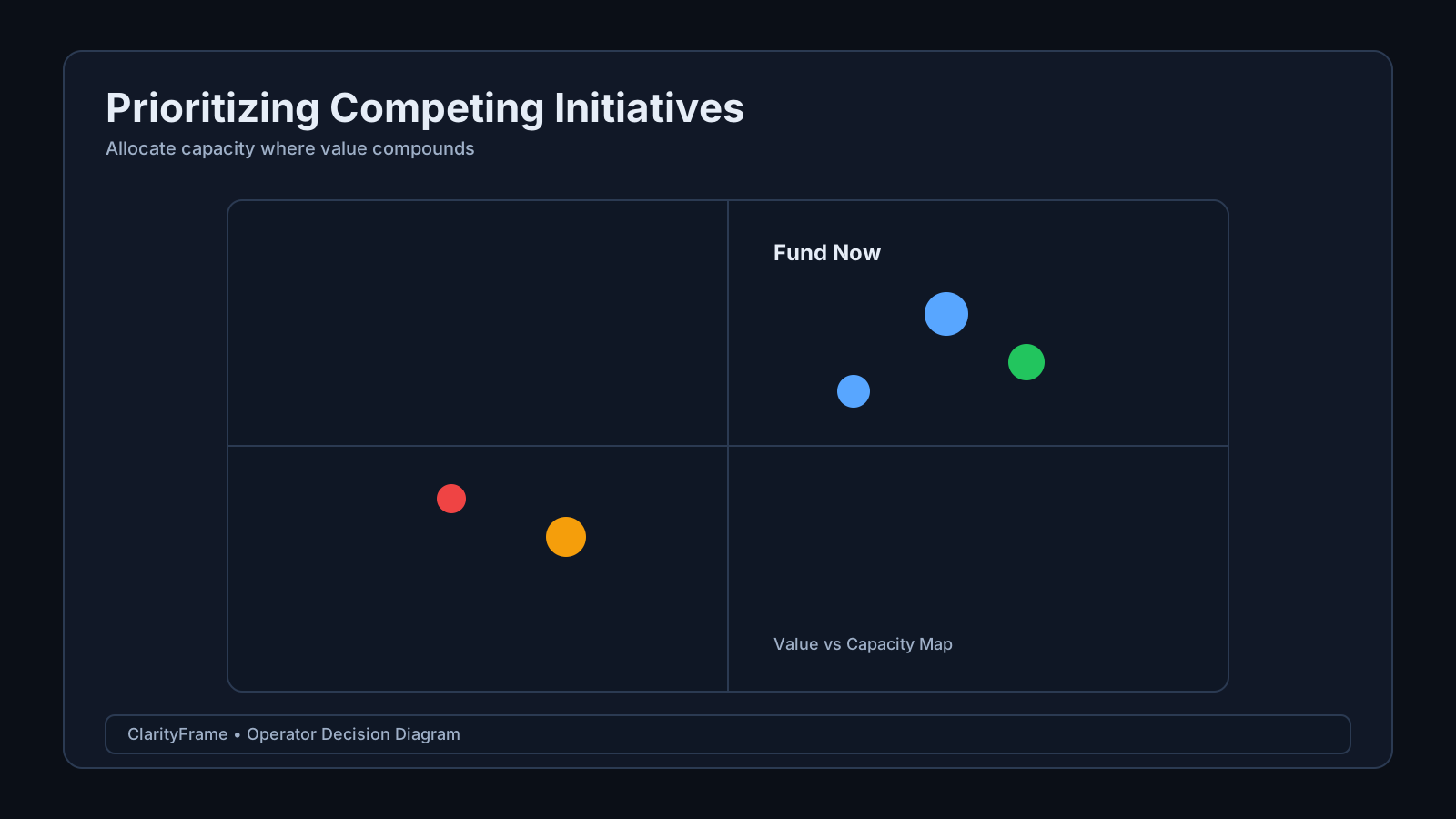
Prioritize competing initiatives by scoring strategic value, capacity fit, and time sensitivity in one shared model. Then fund only the top set your team can execute well. The right outcome is not a perfect list. It is a focused portfolio with clear tradeoffs and explicit deprioritization.
Summary Framework
- Define portfolio capacity before ranking initiatives.
- Score initiatives on value, feasibility, and timing.
- Penalize dependency-heavy work realistically.
- Fund only what fits execution bandwidth.
- Publish explicit “not now” decisions.
Definitions
Competing initiatives: Multiple active opportunities drawing from the same limited resources.
Portfolio capacity: The real amount of strategic work a team can execute without quality collapse.
Deprioritization: Explicitly delaying or rejecting an initiative to protect focus on higher-value work.
Problem Scenario
A founder team has eight initiatives and capacity for three. Every function argues its item is critical.
No common scoring model exists. Priorities change weekly. Execution quality drops across all tracks.
The VCT Portfolio Filter
1) Value score
Estimate expected strategic and financial upside over the next two quarters.
2) Capacity score
Assess team readiness, dependency burden, and implementation complexity.
3) Timing score
Rate urgency based on market window, customer impact, and risk of delay.
Use combined VCT scoring to rank and select only what capacity supports.
Before vs After
Before
Team runs too many initiatives in parallel.
Result: partial progress everywhere, meaningful outcomes nowhere.
After
Team applies VCT, funds top three, and pauses the rest with clear rationale.
Result: deeper execution, faster measurable outcomes, lower internal friction.
Diagnostic Checklist
- What is true portfolio capacity this quarter?
- Which initiatives have highest two-quarter value?
- Which initiatives are blocked by dependencies?
- Which initiatives are truly time-sensitive?
- What are we explicitly not funding right now?
- Who owns each funded initiative outcome?
Common Mistakes
- Ranking ideas without capacity constraints.
- Confusing stakeholder intensity with initiative value.
- Ignoring dependencies in feasibility scoring.
- Avoiding clear “not now” decisions.
When to Seek External Decision Help
If prioritization has become political and tradeoffs are stalled, external facilitation can force objective ranking and close scope quickly.
FAQ
How many initiatives should we run at once?
Only what your portfolio capacity can support with high execution quality.
Should every function get one priority slot?
Not necessarily. Resource allocation should follow strategic value, not equal distribution.
How often should we rerank priorities?
Typically monthly or quarterly, unless major signal changes.
What if a deprioritized initiative is requested by a key stakeholder?
Reevaluate using the same model; do not bypass prioritization rules.
How do we handle urgent unplanned work?
Use a reserved capacity buffer and explicit swap rules.
Can this work in small teams?
Yes. Smaller teams benefit even more from explicit tradeoffs.
Bottom Line
Prioritization is not selecting what to do.
It is selecting what not to do so execution quality stays high.
Substack
Get The Briefs By Email
Operator notes and decision frameworks sent through Substack.
Related Briefs
-
Crisis Decision Framework: How to Triage Company-Threatening EventsHandle company-threatening events by stabilizing first, assigning single owners, and sequencing decisions by urgency.
-
Budget Allocation Tradeoff Framework for Growth and Runway DecisionsAllocate budget with a framework balancing return confidence, downside risk, and runway protection.
-
Product Roadmap Prioritization Framework: Feature vs Platform DecisionsPrioritize roadmap bets by separating feature work from platform work and scoring both against shared criteria.
-
High-Stakes Decisions Under Time Pressure: A Founder PlaybookHow founders can make high-stakes decisions quickly under time pressure without defaulting to panic or paralysis.
-
When DIY Frameworks Fail: How to Know You Need a Thinking PartnerRecognize when the problem is framing, not information, and when a structured outside session will close the decision faster.