Journal
Partnership Decision Framework: When to Co-Sell, Integrate, or Stay Solo
Executive answer
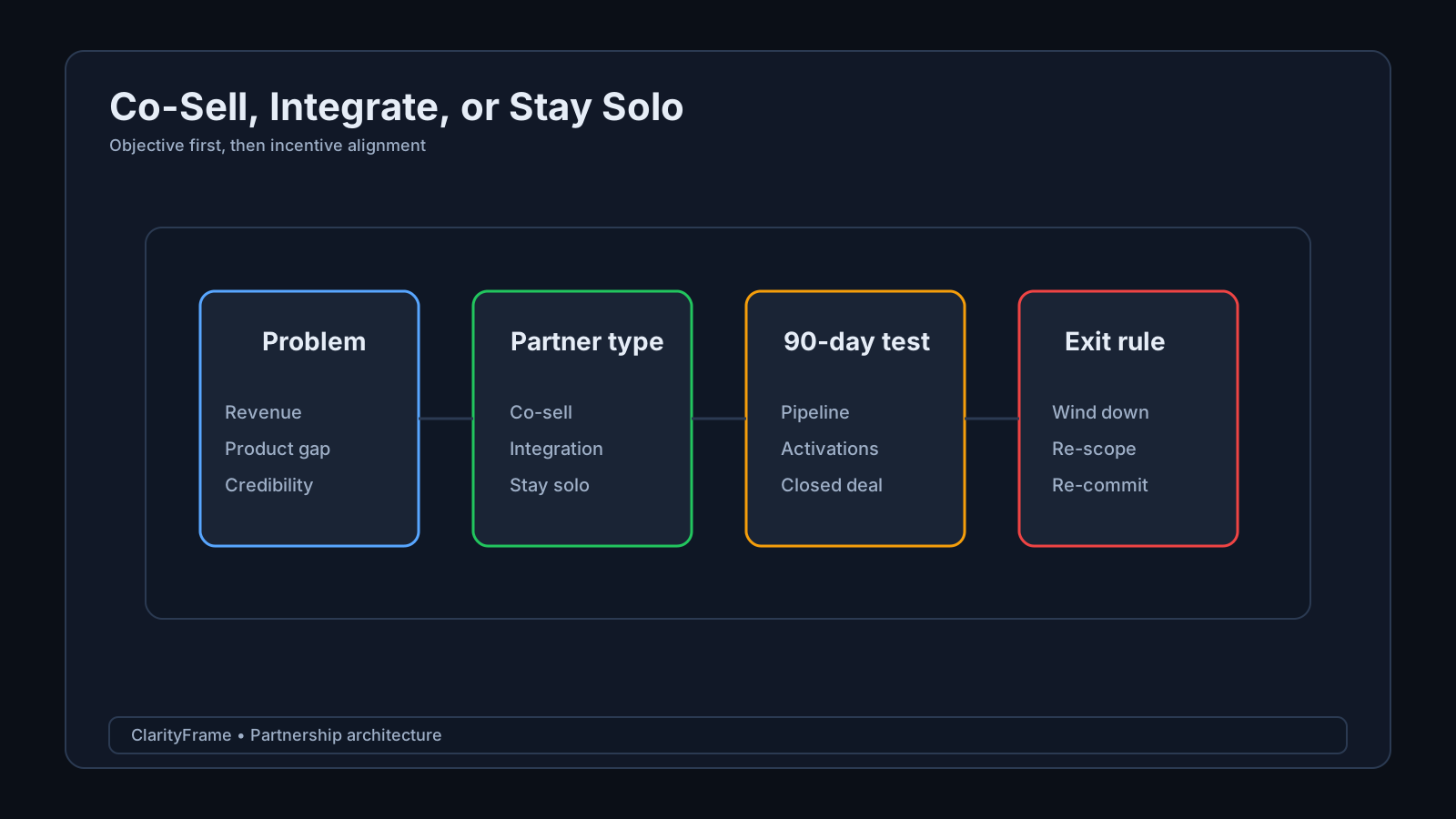
Partnership decisions work when the problem statement is specific, incentives are aligned, and the first 90 days have a defined activation threshold. Most fail because the objective was never clear.
Summary framework
- Define what the partnership is meant to solve.
- Distinguish distribution from integration.
- Assess incentive alignment before signing.
- Set a 90-day validation threshold.
- Write exit criteria up front.
Most partnerships fail not because the partner was bad, but because the reason for partnering was vague from the start.
That is the same structural mistake covered in Vendor Selection Decision Framework and Build vs Buy Framework for AI / Software: vague objectives create expensive relationships.
Definitions
- Co-sell partnership: Two companies selling jointly into shared accounts.
- Integration partnership: A technical product connection that creates combined user value.
- Reseller partnership: A third party selling your product into its own customer base.
- Incentive alignment: The degree to which both parties benefit from the same outcome.
What causes partnerships to underperform?
Three patterns are consistent:
- The partnership solves a perception problem instead of a revenue problem.
- Incentive alignment is assumed instead of designed.
- No activation threshold is defined, so failure drifts on too long.
A 4-step partnership decision framework
1) Name the problem the partnership is solving
Distribution gap, product gap, credibility gap, or geographic gap. Each one requires a different partner type.
2) Evaluate incentive alignment explicitly
If the partner does not make money when your product wins, the partnership will keep sliding down their priority stack.
3) Define the 90-day activation test
Set the first proof point before the agreement starts. Pipeline, revenue, or product activation. Pick one.
4) Write exit criteria before signing
Low-performing partnerships often survive because no one defined what failure looks like.
This is where many teams confuse motion for traction. A partnership meeting cadence is not evidence that the partnership works.
Example scenario
A founder is considering a co-sell agreement with a larger vendor serving the same ICP.
- Decision statement: Does this partnership accelerate revenue faster than the same investment in direct sales?
- Criteria: Incentive alignment, ICP overlap, activation speed, partner capacity.
- Outcome: Proceed with a 90-day pipeline target and wind-down trigger.
- Execution: One executive sponsor on each side and monthly review.
FAQ
How do you evaluate a potential business partnership?
Assess incentive alignment, ICP overlap, and what can actually happen in the first 90 days.
What makes a co-sell partnership succeed?
Aligned incentives, real overlap in buyer profile, and clear executive ownership on both sides.
When should a startup avoid partnerships?
When the partnership is being used as a substitute for direct sales discipline rather than as an accelerant.
How do you exit a bad partnership?
Use the exit criteria defined before signing. If none exist, use a short wind-down plan tied to pipeline reality.
Bottom line
A partnership that cannot state its problem in one sentence is not a strategy. It is deferred accountability.
If the partnership path is being used to avoid a harder direct GTM decision, read this with Go-to-Market Model Decision Framework: PLG vs Sales-Led vs Channel before committing resources.
Substack
Get The Briefs By Email
Operator notes and decision frameworks sent through Substack.
Related Briefs
-
When DIY Frameworks Fail: How to Know You Need a Thinking PartnerRecognize when the problem is framing, not information, and when a structured outside session will close the decision faster.
-
Crisis Decision Framework: How to Triage Company-Threatening EventsHandle company-threatening events by stabilizing first, assigning single owners, and sequencing decisions by urgency.
-
Market Entry Timing Decision Framework: Launch Now or Wait?Decide launch timing with readiness thresholds, competitive risk, and execution confidence.
-
Budget Allocation Tradeoff Framework for Growth and Runway DecisionsAllocate budget with a framework balancing return confidence, downside risk, and runway protection.
-
Making Decisions With Incomplete Data: A Founder Confidence ModelHow founders can make high-quality strategic decisions when data is incomplete, conflicting, or delayed.