Journal
Strategic vs Reversible Decisions: When to Move Fast
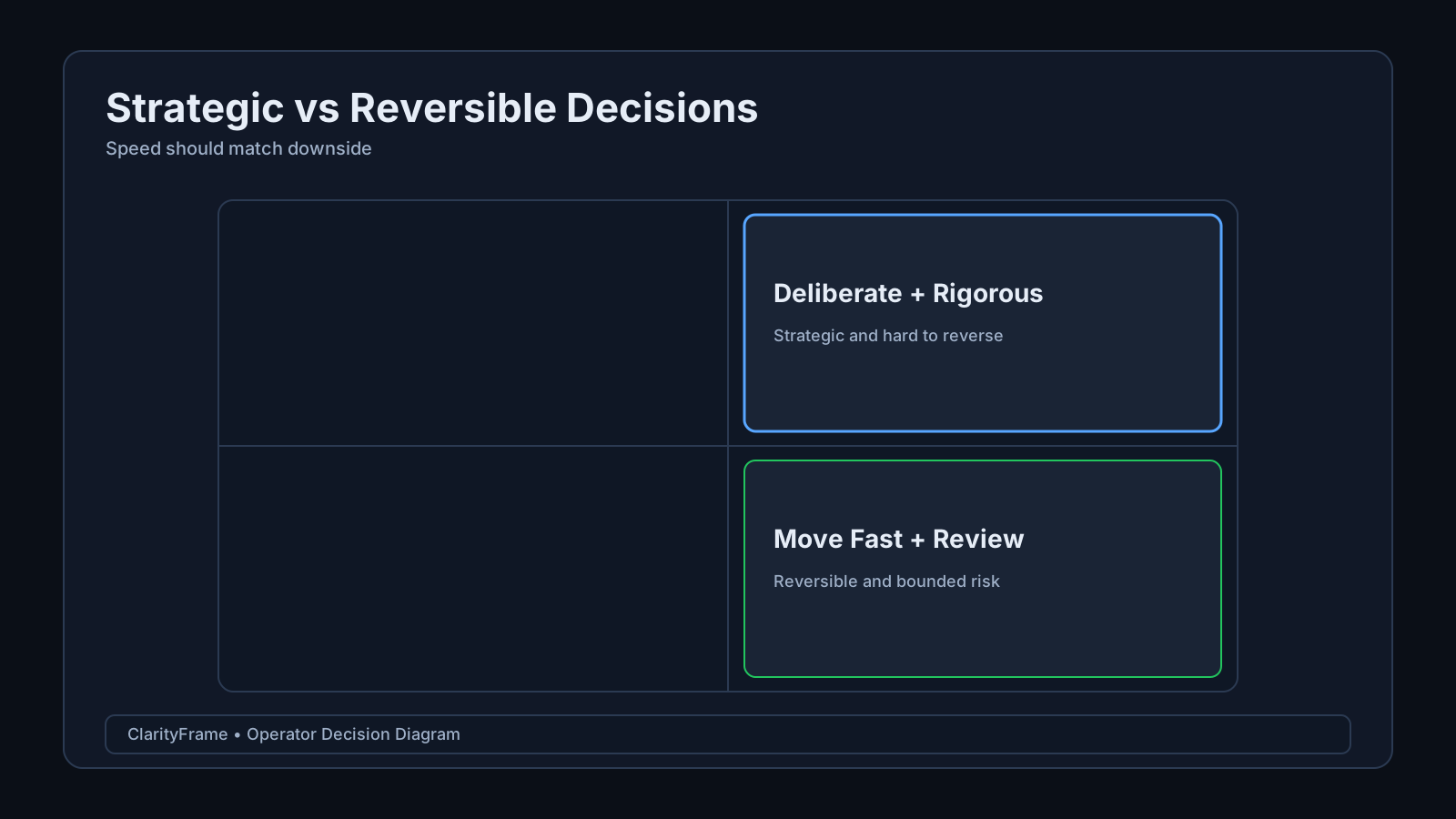
Many teams move at one speed for every decision. That is a costly mistake.
Speed should match reversibility. Move fast where mistakes are cheap to fix. Slow down where mistakes reshape the company.
Executive Answer
Founders should move fast on reversible decisions and deliberately on strategic irreversible decisions. The key is classifying decisions by reversibility, downside magnitude, and lock-in duration before acting. This preserves velocity where possible while protecting the business from costly unforced errors on high-consequence calls.
Summary Framework
- Classify each decision by reversibility.
- Estimate downside if the call is wrong.
- Measure lock-in duration and switching cost.
- Set speed and review rigor accordingly.
- Communicate decision class to all stakeholders.
Definitions
Reversible decision: A call that can be changed quickly with low cost and minimal strategic disruption.
Strategic decision: A call that creates durable consequences, high lock-in, or major downside if wrong.
Lock-in duration: The expected time and cost required to unwind a decision.
Problem Scenario
A founder team debates pricing architecture and ad creative strategy in the same meeting with identical rigor.
Result: ad decisions are slow, and pricing decisions are rushed. Both categories are handled at the wrong speed.
The Speed-by-Class Matrix
Class A: Reversible / low downside
Default to fast decision and fast iteration.
Class B: Reversible / moderate downside
Move quickly with explicit guardrails and short reviews.
Class C: Partially irreversible
Increase rigor and require explicit downside mapping.
Class D: Strategic irreversible
Use deliberate pace, broader input, and strong pre-commit validation.
Before vs After
Before
All decisions receive the same discussion depth.
Result: low-risk decisions clog the system while high-risk calls are under-tested.
After
Team classifies decisions first, then applies matched speed.
Result: higher throughput and better risk control.
Diagnostic Checklist
- How reversible is this decision in 30 days?
- What is the cost of being wrong?
- What is the lock-in period?
- Which dependencies make reversal harder?
- What review depth fits this class?
- Who approves final commitment?
Common Mistakes
- Equating urgency with importance.
- Applying strategic rigor to reversible calls.
- Treating strategic calls like experiments.
- Ignoring lock-in and switching costs.
When to Seek External Decision Help
External support is useful when leaders disagree on decision class or when strategic calls carry meaningful downside under time pressure.
FAQ
Can reversible decisions still be high impact?
Yes. Reversible does not mean unimportant; it means correction is feasible.
How do we classify ambiguous decisions?
Use downside and lock-in as tie-breakers.
Should strategic decisions always be slow?
Not slow for the sake of slowness. Deliberate enough to control downside.
What if teams misclassify often?
Audit outcomes monthly and recalibrate classification standards.
Does this reduce innovation speed?
No. It increases speed where experimentation is safe.
Who should own classification?
The decision owner, reviewed by leadership for high-impact items.
Bottom Line
High-performing teams do not choose between speed and quality.
They choose the right speed for the decision class.
Substack
Get The Briefs By Email
Operator notes and decision frameworks sent through Substack.
Related Briefs
-
AI Adoption Framework: Why AI Exposes Workflow ProblemsA practical AI adoption framework for redesigning broken workflows before automating them with tools, copilots, and platforms.
-
Vendor Selection Decision Framework for High-Risk Business SystemsSelect vendors with a framework balancing reliability, control, lifecycle cost, and exit risk.
-
Resource Allocation Under Constraint: A Framework for Executive TradeoffsAllocate scarce capacity with a framework that protects high-impact execution.
-
Build vs Buy Framework for AI Tools and Software DecisionsDecide whether to build or buy with a practical framework for speed, control, and lifecycle cost.
-
Decision Cadence Framework: How Teams Make Better Calls WeeklyA practical weekly decision cadence framework to reduce strategic drama, lock ownership, and improve execution quality under pressure.