Journal
When Founders Disagree: A Resolution Framework That Protects the Company
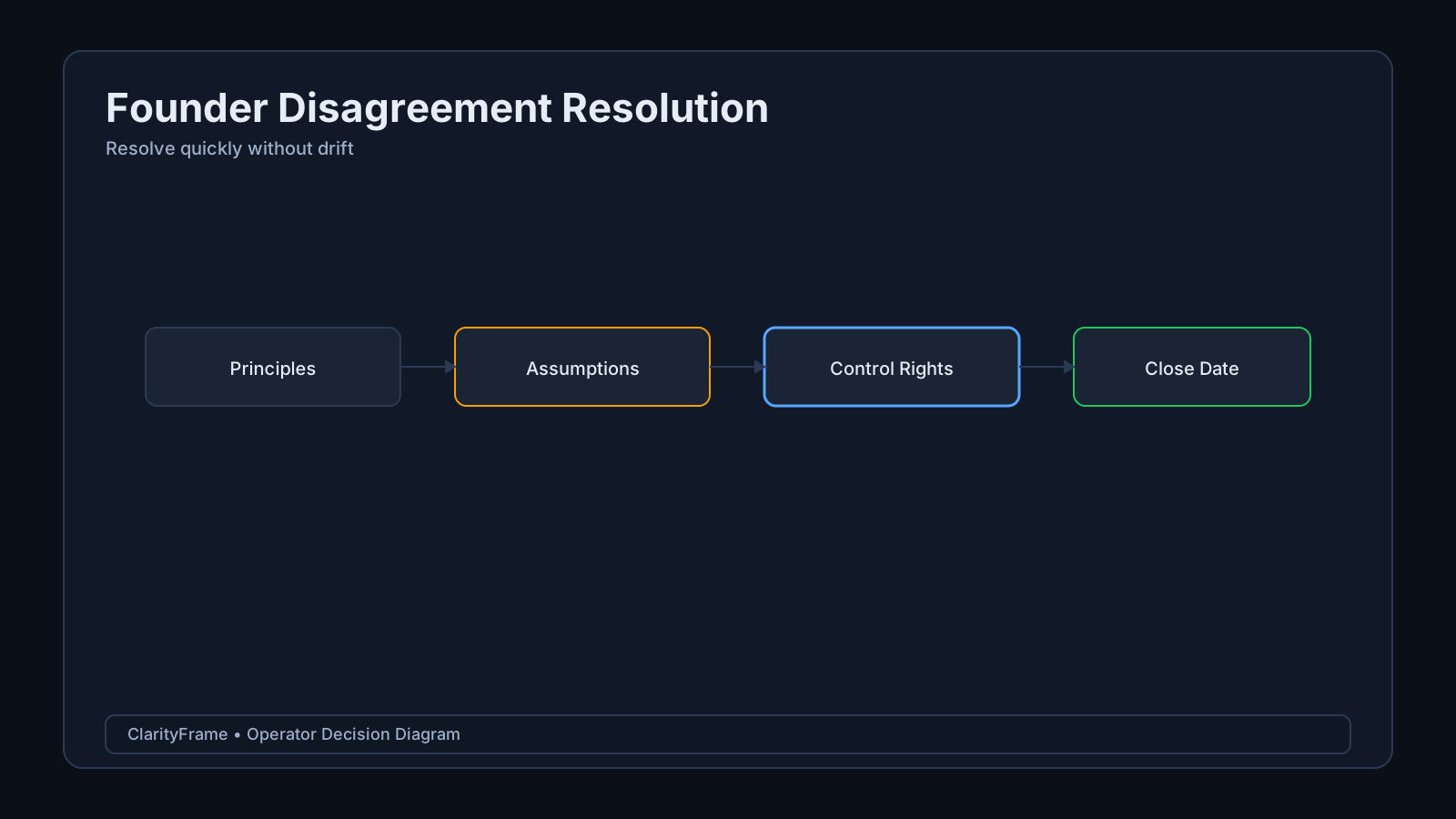
Founder disagreement is normal. Unresolved founder disagreement is expensive.
When core leaders stay misaligned, teams slow down, narratives fragment, and execution quality drops across functions.
Executive Answer
When founders disagree on a high-stakes decision, resolve it by separating principles from preferences, using pre-agreed decision rights, and setting a forced resolution date. The objective is not perfect interpersonal harmony. It is a clear decision that preserves trust, operating clarity, and execution velocity.
Summary Framework
- Clarify the exact decision in dispute.
- Separate principle-level concerns from style-level preferences.
- Apply pre-defined founder decision rights.
- Escalate to a forced resolution deadline.
- Publish one unified decision narrative to the team.
Definitions
Founder disagreement: A strategic conflict between co-founders on direction, risk, or timing.
Principle conflict: A disagreement about core assumptions, values, or strategic thesis.
Preference conflict: A disagreement about style, sequencing, or communication approach.
Problem Scenario
Two founders disagree on whether to focus on enterprise expansion or PLG acceleration. Both arguments are strong. Leadership team is waiting.
Each week, direction shifts subtly. Product and GTM teams hedge. Hiring plans stall.
The cost is no longer the disagreement. The cost is the ambiguity.
The PACT Resolution Model
1) Principle check
List non-negotiables for each founder. If these conflict directly, decision rights must be explicit.
2) Assumption exposure
Write the top three assumptions each side is making. Hidden assumptions create repetitive conflict.
3) Control rights
Use a pre-agreed ownership map: who has final call on market, product, hiring, and capital decisions.
4) Time-bound close
Set a hard resolution date and commit to one message for the company immediately after.
Before vs After
Before
Founders keep discussing in fragments across multiple meetings.
Result: team uncertainty, duplicated work, and political behavior.
After
Founders run PACT, apply decision rights, and close by a defined date.
Result: one company narrative, cleaner priorities, and restored execution pace.
Diagnostic Checklist
- Is this a principle conflict or preference conflict?
- What assumptions are each founder making?
- Are decision rights explicit for this domain?
- What is the latest acceptable decision date?
- What single narrative will be communicated to the team?
- What trigger would justify reopening the issue?
Common Mistakes
- Treating all disagreements as consensus-required.
- Arguing positions instead of exposing assumptions.
- Avoiding explicit decision rights to preserve comfort.
- Sending mixed messages after resolution.
When to Seek External Decision Help
External help is useful when founder trust is intact but convergence is not happening. A neutral operator can force structure, surface hidden assumptions, and close the gap quickly.
FAQ
Is disagreement between founders a bad sign?
No. Persistent unresolved disagreement is the risk, not disagreement itself.
Should investors decide in founder conflicts?
They can inform, but final internal decision ownership should remain explicit.
What if decision rights were never defined?
Define them now by domain and document immediately. Ambiguity compounds quickly.
Can consensus still be the goal?
Sometimes. But high-stakes calls need a closure mechanism when consensus fails.
How fast should founder conflicts be resolved?
Within a bounded window tied to business impact, usually days not months.
How do we rebuild alignment after a hard call?
Use one unified rationale, clear owner mapping, and immediate execution milestones.
Bottom Line
Founder disagreement is manageable. Founder ambiguity is costly.
Resolve conflict with clear rights, clear deadlines, and one company-level narrative.
Substack
Get The Briefs By Email
Operator notes and decision frameworks sent through Substack.
Related Briefs
-
Founder Decision Framework: Why Clarity Matters Even With Strong AdvisorsAdvisors expand optionality. This founder decision framework helps compress options into clear final decisions and execution ownership.
-
Equity vs Salary: Compensation Decision Framework for Early HiresStructure early-hire compensation with consistent equity bands, runway-aware cash offers, and realistic risk tolerance.
-
When to Replace a Leader: A Decision Framework for FoundersDecide replacement timing using performance trajectory, risk, and transition readiness criteria.
-
Board and Investor Alignment Framework: When Stakeholders DisagreeHandle board and investor disagreement with cleaner authority maps, shared facts, and explicit decision timelines.
-
Hire vs Contractor vs Agency Decision Model for Revenue-Critical WorkChoose the right staffing model using timeline, control, and execution risk criteria.