Journal
Founder Decision Framework: Why Clarity Matters Even With Strong Advisors
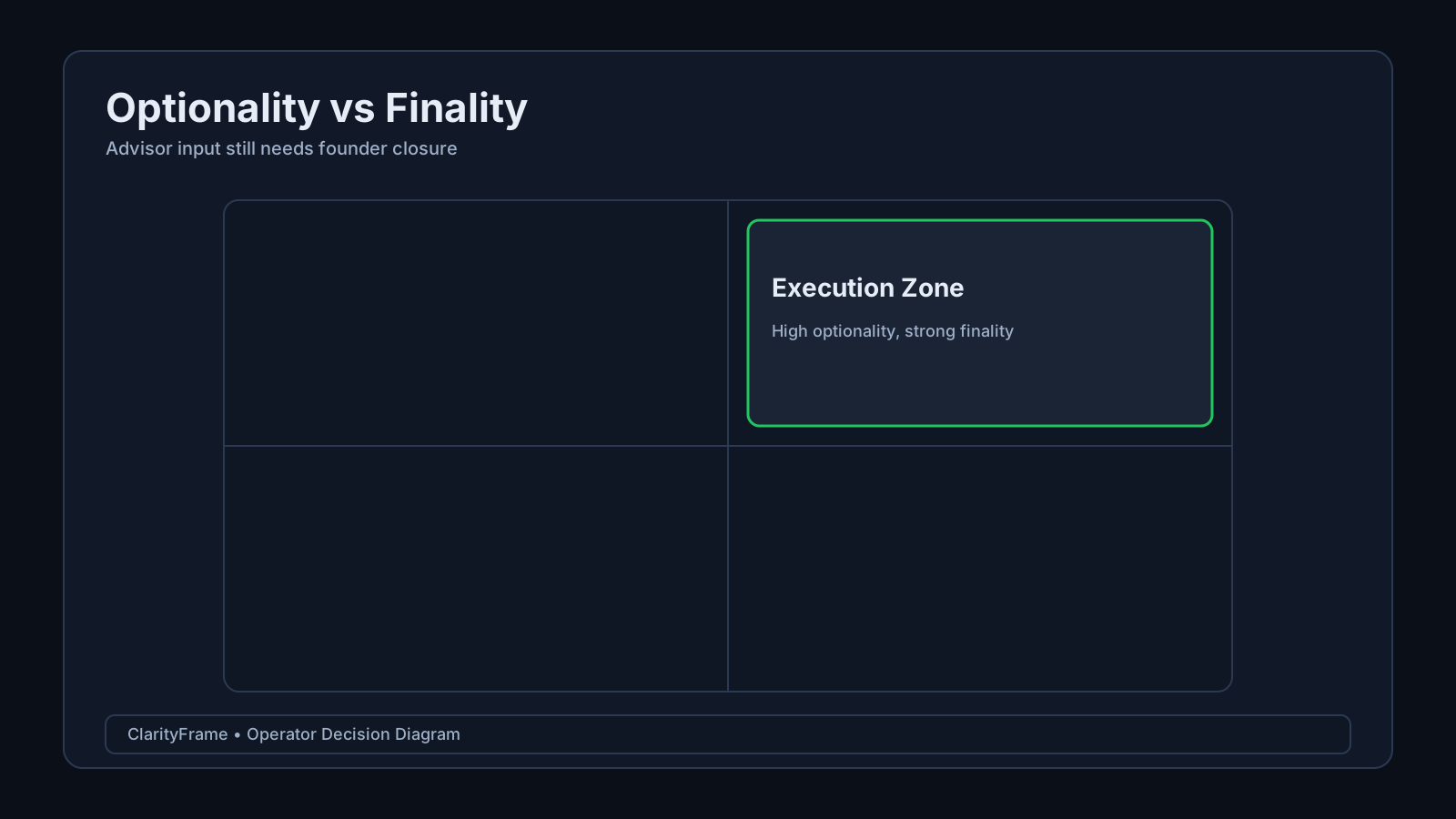
Strong advisors and investors improve optionality, but founders still own finality. The real job is not collecting more perspectives. It is converting broad input into one committed call with clear ownership, timing, and tradeoffs. When that compression step is missing, teams stay busy, advisors stay helpful, and the company still does not move.
Summary Framework
- Expand option quality before commitment windows open.
- Set a decision deadline before gathering input.
- Separate advice collection from final ownership.
- Publish the final call with rejected alternatives.
- Track one success signal and one correction trigger.
Definitions
- Optionality: The process of expanding, testing, and comparing possible paths before commitment.
- Finality: The act of selecting one path, naming the tradeoffs, and assigning execution ownership.
- Advisory input: Perspective offered to improve decision quality, without necessarily carrying decision authority.
- Decision deadline: The date by which the founder commits to one path, regardless of whether every advisor agrees.
- Rejected alternative: A path considered seriously but intentionally not chosen, documented to reduce later re-litigation.
Why do founders still get stuck when they have strong advisors?
Strong advisors improve the quality of the option set. They do not make the founder’s final decision for them.
That gap matters because advisory quality and execution quality are different things. A founder can leave a great board conversation with better ideas and still create slower execution if nobody converts those ideas into one call.
The common failure pattern looks like this:
- more input keeps arriving
- options keep expanding
- the decision window never really closes
- execution stalls while everyone feels informed
If the team is already looping, Why Smart Teams Stall on Big Decisions covers the group mechanics behind the stall.
What is the difference between optionality and finality?
Optionality asks, “What could we do?” Finality asks, “What are we doing now?”
Optionality is useful early. Finality is what creates execution. Companies need both, but they need them in sequence.
When founders blur the two, they stay in option-expansion mode long after the business needs a committed path.
How should founders use advisors without losing decision velocity?
Use a two-step sequence.
1. Expand the option set intentionally
Use advisors for second-order effects, edge cases, and blind spots. This is the right stage for pushing the decision wider before it closes.
2. Compress to a founder call quickly
Set the deadline before the advisory process starts. Once input is collected, publish one clear decision with:
- the chosen path
- the rejected alternatives
- the reason for the call
- the owner and timing
This protects the upside of strong advisors without outsourcing the founder’s job.
For the pattern where advisors expand options but the founder still needs to close the call, When DIY Frameworks Fail: How to Know You Need a Thinking Partner is the direct follow-on.
What are the most common mistakes when founders rely on advisors?
- Collecting advice without a decision deadline.
- Treating every advisor suggestion as equally actionable.
- Using advisory conversations as a substitute for commitment.
- Closing the discussion without naming rejected alternatives.
- Failing to assign one accountable execution owner after the call.
When should you not use this framework?
- Early discovery phases where no real decision window exists yet.
- Low-impact decisions with minimal tradeoff.
- Situations where legal, regulatory, or contractual constraints effectively dictate the answer.
Example scenario: how does a founder convert advisor input into a final call?
A founder receives conflicting investor advice on pricing and market focus ahead of launch. One advisor wants broader market coverage. Another wants a narrower segment-first approach. Both arguments are thoughtful, and both expand the option set.
The founder sets a seven-day decision window, collects inputs, locks criteria around margin, onboarding complexity, and sales cycle, then chooses one segment-first strategy with one GTM owner.
Decision statement: broad launch or segment-first launch.
Criteria: margin profile, onboarding load, cycle time, and execution focus.
Outcome: one path is selected, and the rejected path is documented.
Alternate option that loses: running two segments in parallel, because it preserves optionality at the cost of diluted execution and noisy attribution.
Success signal: pipeline quality improves in the target segment within 30 days.
Correction trigger: if conversion or cycle-time targets miss for two review cycles, reopen the decision using the documented fallback alternatives.
FAQ
Why do founders need clarity even with strong advisors?
Because advisors improve possibilities, not final commitment. The founder still has to compress input into one call the team can execute.
What is the difference between optionality and finality?
Optionality expands choices. Finality closes one path with tradeoffs, ownership, and timing. Companies need optionality early and finality when execution must begin.
How much advisor input is too much?
It becomes too much when new advice keeps arriving after the decision deadline should have closed. At that point, more perspective is usually reducing speed more than improving quality.
Should founders try to get advisor consensus before acting?
No. Consensus can be useful, but it is not the same as clarity. Founders need informed input, then a clear final call even if some advisors would have chosen differently.
What should a founder publish after a major decision?
They should publish the chosen path, the rejected alternatives, the reason for the call, the execution owner, and the signal that would force a revision. That is what turns input into movement.
When does outside clarity help more than more advisor input?
Outside clarity helps when the problem is no longer option generation but commitment compression. If the founder already has enough perspectives and still cannot close the call, the bottleneck is usually framing or finality.
Bottom line
Advisors help founders see more. Founders still have to choose one path and move.
The discipline is not collecting better advice forever. It is converting good advice into an executable final decision. When that compression needs structure and speed, use Clarity Sprint or Clarity Ignite, depending on the decision scope.
Substack
Get The Briefs By Email
Operator notes and decision frameworks sent through Substack.
Related Briefs
-
Founder Decision Fatigue Framework: Protect Judgment Under LoadA practical framework for reducing founder decision fatigue by redesigning ownership, delegation, and strategic decision flow.
-
When Founders Disagree: A Resolution Framework That Protects the CompanyHow co-founders can resolve high-stakes disagreements quickly without damaging trust, velocity, or strategic coherence.
-
When DIY Frameworks Fail: How to Know You Need a Thinking PartnerRecognize when the problem is framing, not information, and when a structured outside session will close the decision faster.
-
High-Stakes Decision-Making Framework for FoundersA practical framework to define the decision, set criteria, compare options, and commit to execution with clarity.
-
Equity vs Salary: Compensation Decision Framework for Early HiresStructure early-hire compensation with consistent equity bands, runway-aware cash offers, and realistic risk tolerance.