Journal
Decision Cadence Framework: How Teams Make Better Calls Weekly
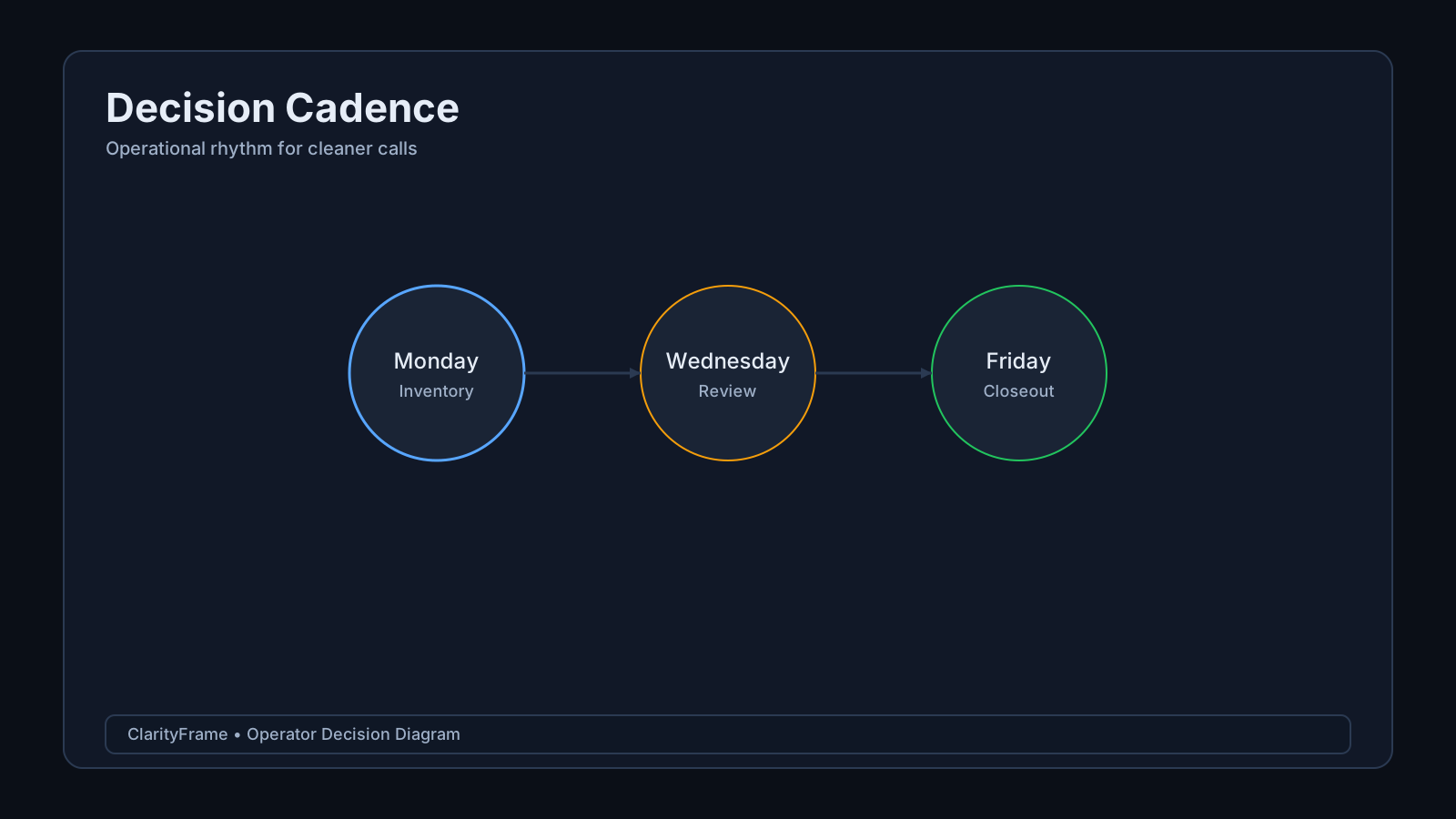
Teams make better decisions when commitment happens on a fixed rhythm instead of in reactive bursts. A decision cadence framework reduces re-litigation, clarifies ownership, and turns high-stakes calls into a repeatable operating system rather than a personality contest. The value is not more meetings. The value is fewer open loops, cleaner decision rights, and faster execution after the call is made.
Summary Framework
- Inventory open decisions every week.
- Classify each decision by downside and reversibility.
- Assign one owner and one deadline.
- Publish each committed call in writing.
- Review outcomes on a fixed loop.
Definitions
- Decision cadence: A recurring operating rhythm for surfacing, classifying, closing, and reviewing meaningful decisions.
- Decision drama: Repeated debate, escalations, and meeting churn caused by weak commitment mechanics rather than weak intelligence.
- Decision brief: A short written record of what was decided, why, what was rejected, and what signal would trigger revision.
- Re-litigation: Reopening a decision without new evidence, often because ownership or criteria were never locked.
- Outcome review: A scheduled check on whether the decision is working, distinct from a reactive postmortem after failure.
What is decision cadence?
Decision cadence is the weekly rhythm a team uses to process meaningful decisions on purpose rather than by interruption. It creates a fixed loop for identifying open calls, assigning owners, forcing close dates, and reviewing the results after execution.
Without a cadence, every issue arrives as a special case. That creates status churn, meeting sprawl, and the illusion of progress without actual commitment.
Why does decision drama slow execution?
Teams without cadence keep paying the same tax.
- The same issue appears in three meetings with three different framings.
- Criteria shift after options are discussed.
- Leaders keep parallel priorities open to avoid disappointing someone.
- Decisions close verbally but not operationally.
The result is not just slower strategy. It is slower execution across product, sales, hiring, and resource allocation.
If this is already loading the founder directly, see Founder Decision Fatigue Is a Systems Problem.
How do you run a weekly decision cadence?
Use one simple weekly sequence.
Monday: inventory open decisions
List the decisions that are still materially open. Most teams discover they are carrying more open loops than they can name in real time.
For each item, note:
- the decision statement
- the owner
- the deadline
- the consequence of delay
Wednesday: review the real decisions
Use midweek review for the calls that cross functions, affect multiple teams, or carry meaningful downside. This is where you lock criteria before the room starts debating options.
If a decision is reversible and bounded, it should often leave this meeting with a close date instead of returning next week.
Friday: publish decision closeout
Close the week by writing down:
- what was decided
- why it was chosen
- what alternatives were rejected
- who owns execution
- what signal will be reviewed next
This final step is where cadence becomes operating discipline rather than just another meeting pattern.
How should teams classify decision types?
Not all decisions deserve the same level of review.
| Type | Speed | Review Standard | Revision Rule |
|---|---|---|---|
| Reversible | Fast | Good-enough signal | Adjust quickly |
| Irreversible | Deliberate | Higher confidence plus downside mapping | Reopen only on clear trigger |
Teams that classify decisions well avoid both rash moves and unnecessary delay. If a team does not know which bucket a call belongs in, that ambiguity itself usually needs to be resolved first.
For the underlying logic, Strategic vs Reversible Decisions: When to Move Fast is the adjacent brief.
What are the most common mistakes in decision cadence?
- Treating every decision as high-stakes.
- Running decision review without locked criteria.
- Closing meetings without written ownership.
- Reviewing outcomes only when something goes wrong.
- Letting low-value operational noise consume the same time as hard strategic calls.
When should you not use this framework?
- Crisis incidents that need containment immediately.
- Tiny operational choices where process cost exceeds decision risk.
- Pure discovery work where no commitment window exists yet.
- One-off emergency situations where a weekly rhythm is too slow.
Example scenario: how does a weekly cadence improve a packaging decision?
A product and sales leadership team is deciding Q2 packaging changes. The issue has appeared in meetings for three weeks, but the criteria keep shifting between margin, win rate, and implementation speed.
Using a weekly cadence, the team inventories the open decision on Monday, locks criteria on Wednesday, and publishes the final packaging call on Friday.
Decision statement: choose one Q2 package structure.
Criteria: margin impact, win rate, implementation load, and support burden.
Outcome: one package model is chosen with one GTM owner and one review date.
Alternate option that loses: keeping two packaging options live “for flexibility,” because that preserves political comfort while pushing complexity into execution.
Success signal: win rate holds while margin improves into the target range.
Correction trigger: if support tickets or implementation time breach the agreed threshold for two weeks, reopen the decision on the next cadence review.
FAQ
What is a decision cadence?
A decision cadence is a recurring rhythm for surfacing, classifying, closing, and reviewing meaningful decisions. Its purpose is to prevent re-litigation and keep decision quality from depending on who shouted loudest that week.
How often should leadership teams review major decisions?
Weekly is usually the right default. It is frequent enough to catch open loops early and slow enough to separate real strategic calls from daily operational noise.
What should go into a decision brief?
A decision brief should state what was decided, why it was chosen, what was rejected, who owns execution, and what signal would trigger revision. If those elements are missing, the decision often reopens later by accident.
Does every decision need the same process?
No. Reversible decisions should move faster with lighter review. Irreversible or high-downside decisions need more pressure-testing and clearer documentation before commitment.
Why do teams keep revisiting the same issues?
They usually revisit issues because the original decision lacked stable criteria, a final owner, or a written closeout. The meeting ended, but the decision never really did.
When is a weekly cadence too much?
It is too much when the team is small, the decisions are trivial, or the organization is in acute crisis. In those cases, the cadence should compress or simplify rather than become bureaucratic.
Bottom line
Decision cadence is not about adding ceremony. It is about making sure real decisions close on purpose, with ownership and review baked in.
If your team keeps revisiting the same strategic calls, the missing ingredient is usually cadence, not intelligence. When you need to install that rhythm fast, start with Clarity Sprint.
Substack
Get The Briefs By Email
Operator notes and decision frameworks sent through Substack.
Related Briefs
-
How to Stop Decision Loops in Leadership TeamsA practical model to prevent reopened decisions, repeated debate, and execution drift in leadership teams.
-
AI Adoption Framework: Why AI Exposes Workflow ProblemsA practical AI adoption framework for redesigning broken workflows before automating them with tools, copilots, and platforms.
-
Big Decision Framework: Why Smart Teams Stall and How to MoveA practical 4-step decision framework to reduce team friction, lock ownership, and execute high-stakes calls with speed and confidence.
-
Strategic vs Reversible Decisions: When to Move FastHow founders can separate strategic decisions from reversible ones and set the right speed for each.
-
What to Do When Your Team Won't CommitHow founders can move teams from endless discussion to clear commitment and accountable execution.