Journal
What to Do When Your Team Won't Commit
Teams rarely say “we refuse to commit.”
Instead, they ask for more analysis, add caveats, or keep alternatives open. It sounds thoughtful but functions like avoidance.
Executive Answer
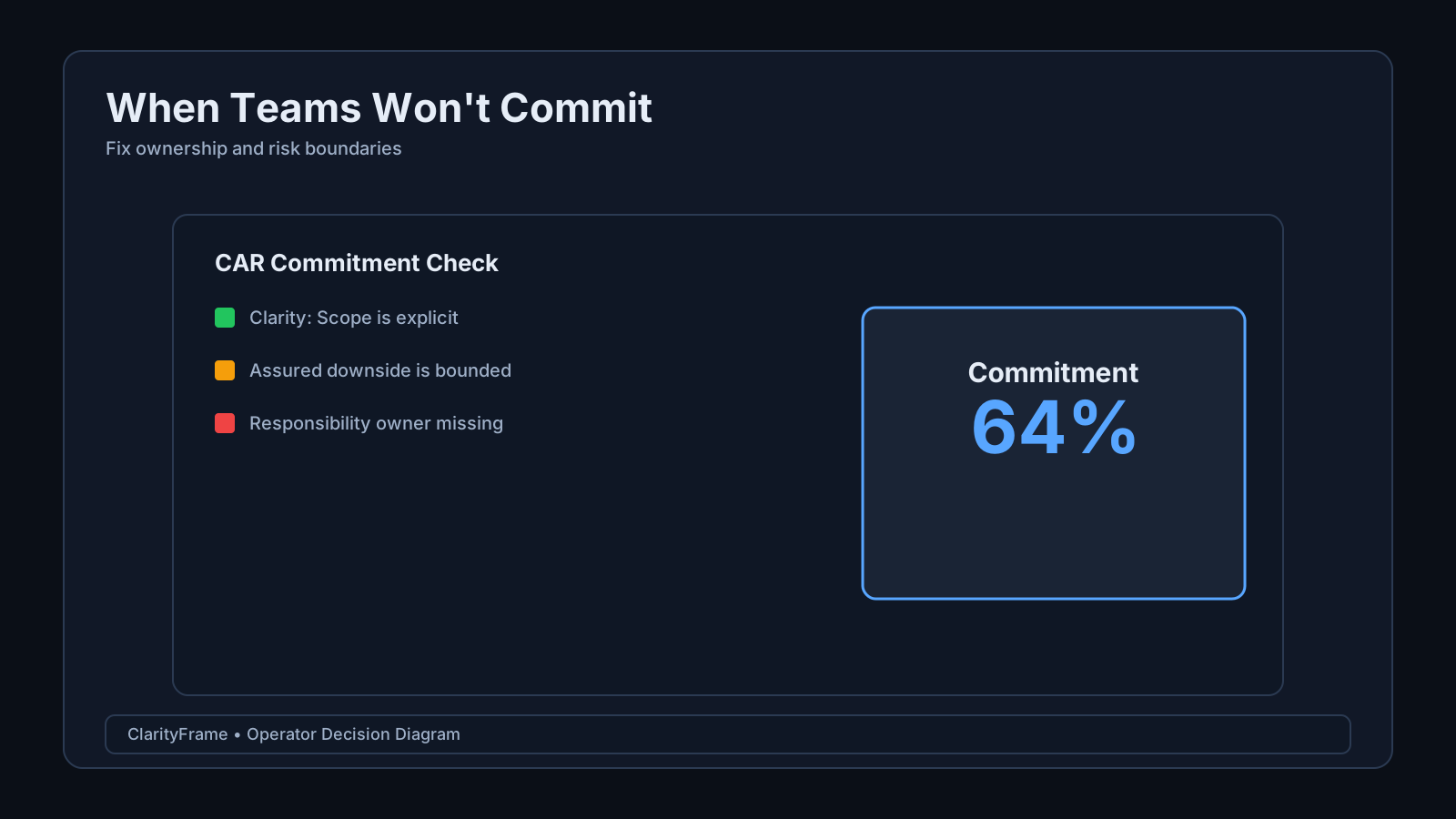
When a team will not commit, diagnose whether the blocker is clarity, risk, or accountability, then remove that blocker directly. Commitment improves when decision scope is explicit, downside is bounded, and ownership is unmistakable. Without these conditions, teams optimize for safety instead of forward motion.
Summary Framework
- Diagnose the real blocker behind non-commitment.
- Clarify decision scope and success criteria.
- Bound downside to reduce perceived personal risk.
- Assign explicit owner and accountability window.
- Confirm commitment in writing.
Definitions
Non-commitment pattern: Repeated deferral behavior after decision discussion appears complete.
Accountability window: The period in which an owner must execute and report outcome signals.
Bounded downside: A defined maximum loss if the chosen path underperforms.
Problem Scenario
Leadership agrees in principle on a GTM direction, but nobody starts execution. Each function requests one more iteration of analysis.
The issue is not intelligence. The issue is unowned risk.
The CAR Accountability Model
1) Clarity
Define exactly what is being committed and what is out of scope.
2) Assured downside
Set guardrails so individuals are not personally exposed to unbounded failure.
3) Responsibility
Assign one owner, one timeline, and one outcome signal.
Before vs After
Before
Decision language is vague and collective.
Result: everyone is involved, no one is accountable.
After
Team uses CAR and confirms owner + guardrails + timeline in writing.
Result: commitment becomes visible and execution starts.
Diagnostic Checklist
- Is decision scope precise enough to execute now?
- Do people understand downside boundaries?
- Is there a single accountable owner?
- Is timeline explicit and near-term?
- Is success signal measurable?
- Was commitment documented and shared?
Common Mistakes
- Assuming silence equals commitment.
- Assigning accountability to a group instead of a person.
- Leaving downside undefined.
- Rewarding over-analysis after close.
When to Seek External Decision Help
External support helps when leadership trust is intact but behavioral commitment is low. A neutral facilitator can force explicit ownership and close ambiguity fast.
FAQ
Why do smart teams avoid commitment?
Usually because risk ownership and downside limits are unclear.
Is more analysis ever the right answer?
Sometimes, if a critical uncertainty can be resolved quickly and materially changes risk.
How do I make commitment visible?
Use written owner, timeline, and success signal with leadership visibility.
What if owner confidence is low?
Reduce scope, tighten guardrails, and shorten the accountability window.
Should founders own every high-stakes commitment?
No. Founders should own only the decisions that require founder-level control.
How quickly should teams commit after discussion?
As soon as scope, downside, and ownership are explicit.
Bottom Line
Commitment failure is usually a system issue, not a motivation issue.
Fix clarity, risk boundaries, and ownership, then execution follows.
Substack
Get The Briefs By Email
Operator notes and decision frameworks sent through Substack.
Related Briefs
-
Big Decision Framework: Why Smart Teams Stall and How to MoveA practical 4-step decision framework to reduce team friction, lock ownership, and execute high-stakes calls with speed and confidence.
-
How to Stop Decision Loops in Leadership TeamsA practical model to prevent reopened decisions, repeated debate, and execution drift in leadership teams.
-
Decision Cadence Framework: How Teams Make Better Calls WeeklyA practical weekly decision cadence framework to reduce strategic drama, lock ownership, and improve execution quality under pressure.
-
Founder Decision Framework: Why Clarity Matters Even With Strong AdvisorsAdvisors expand optionality. This founder decision framework helps compress options into clear final decisions and execution ownership.
-
Decision Ownership Framework for LeadersA practical framework for assigning clear decision ownership so execution moves without confusion or escalation drag.