Journal
Big Decision Framework: Why Smart Teams Stall and How to Move
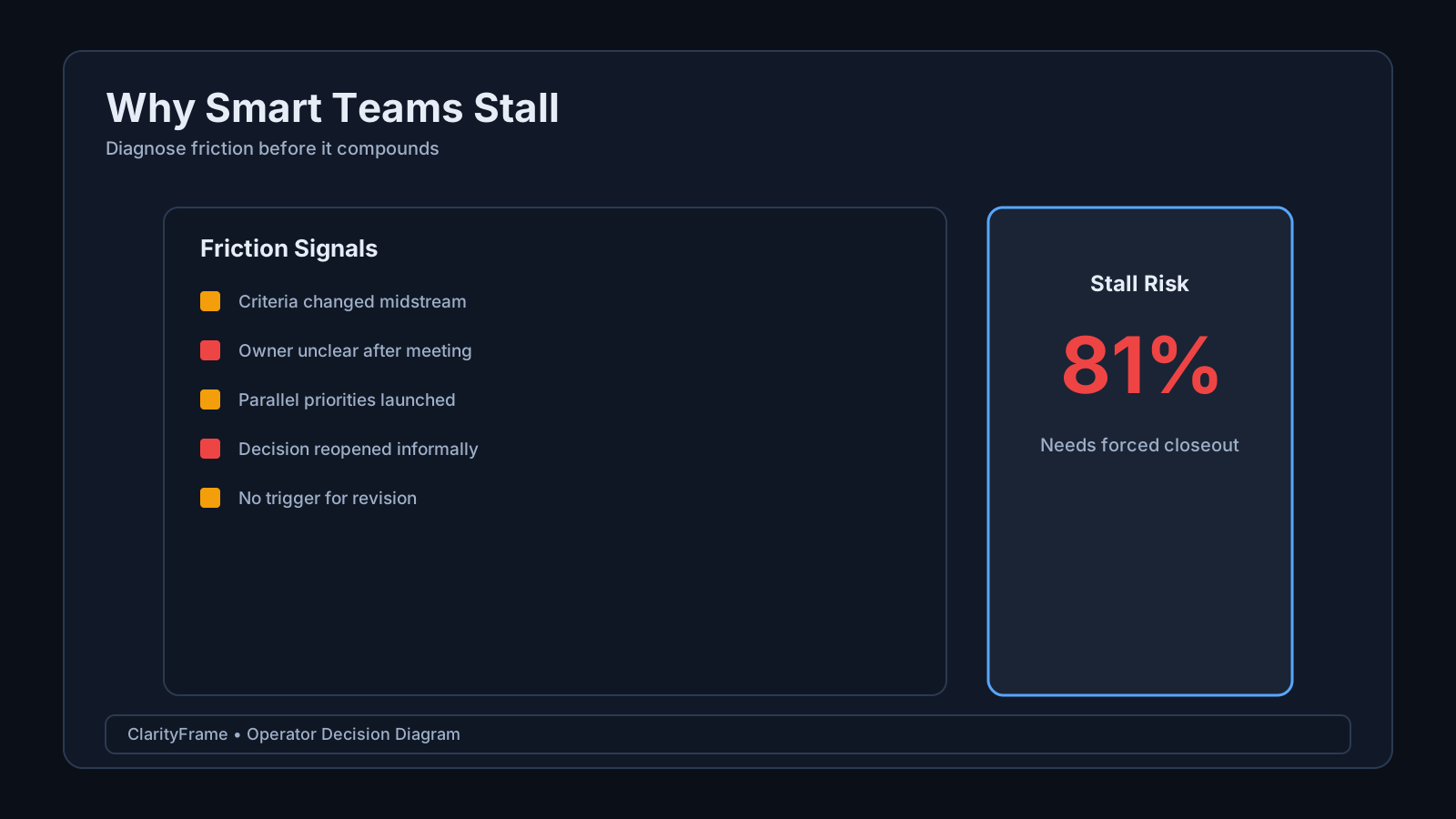
Smart teams usually stall not because they lack intelligence, but because commitment mechanics are weak. A good big-decision framework fixes sequence: define the call, lock criteria, bound disagreement, then publish one final decision brief with ownership and revision logic. The problem is rarely thinking quality alone. It is the absence of a structure that turns discussion into commitment.
Summary Framework
- Define the decision before debating options.
- Lock criteria before evidence review starts.
- Time-box disagreement and assign a decider.
- Publish one decision brief after commitment.
- Track one success signal and one correction trigger.
Definitions
- Decision friction: Repeated delay caused by unstable criteria, unclear ownership, or unresolved tradeoffs after a decision meeting.
- Commitment mechanics: The rules that convert discussion into a closed decision with ownership, timing, and follow-through.
- Decision brief: A short written summary of what was chosen, why, what was rejected, and what would trigger revision.
- Time-boxed disagreement: A bounded debate window after which one decider closes the issue instead of letting argument continue indefinitely.
- Correction trigger: A pre-defined signal that reopens a decision because evidence changed, not because discomfort returned.
Why do smart teams stall on big decisions?
Most teams over-invest in optionality and under-invest in finality. They gather more data, surface more opinions, and run more meetings, but never close the issue tightly enough for execution to start cleanly.
That creates a familiar pattern:
- one more data cut appears every week
- success metrics shift midstream
- nobody is clearly accountable for the final call
- teams hedge by carrying competing priorities in parallel
The result is not thoughtful strategy. It is well-organized indecision.
What is decision friction?
Decision friction is the drag created when a team has technically discussed a call but has not operationally closed it. The room may feel aligned in the moment, but the decision still leaks because criteria, ownership, or revision rules were never fixed.
You can usually spot friction when the same issue returns with new language but the same underlying tradeoff.
How should teams use a 4-step big decision framework?
1. Frame the decision before debate
Write the decision statement before anyone argues options. A room cannot evaluate alternatives fairly if it has not agreed on the exact call being made.
Good framing includes:
- scope of the decision
- timeline for commitment
- consequence of delay
2. Lock decision criteria upfront
Criteria should be stable throughout the conversation. If they change after options are reviewed, the comparison is no longer honest.
This is where most “smart team” stalls begin. The room looks analytical, but it is actually moving the goalposts.
3. Time-box disagreement
Healthy disagreement improves a decision. Endless disagreement destroys one.
Use one bounded window to debate the real tradeoffs. If the team still splits, assign one decider to close the call and own the consequence.
4. Publish the call in one paragraph
After commitment, write down:
- what was chosen
- why it was chosen
- what was rejected
- who owns execution
- what would trigger a revision
This is what turns a meeting into a decision rather than a memory of a meeting.
For teams that need a recurring operating rhythm around this, Decision Cadence Beats Decision Drama is the next layer.
How should teams handle reversible vs irreversible decisions?
| Type | Typical Speed | Standard | Revision Rule |
|---|---|---|---|
| Reversible | Fast | 70 to 80 percent confidence | Adjust quickly when signal changes |
| Irreversible | Deliberate | Higher confidence plus downside mapping | Revise only on pre-defined trigger |
Teams stall when they give reversible decisions irreversible process, or worse, treat irreversible decisions like quick experiments.
What are the most common mistakes that kill decision velocity?
- Debating options before defining the decision.
- Letting criteria change once discussion starts.
- Treating consensus as mandatory on every strategic call.
- Ending meetings without a written commitment brief.
- Allowing multiple owners to believe they hold the final word.
When should you not use this framework?
- Emergency incidents where containment matters more than deliberation.
- Low-impact choices where the process cost exceeds the decision risk.
- Purely exploratory work with no commitment window yet.
Example scenario: how does a team close a contested growth-channel decision?
A leadership team must choose one Q2 growth channel. The options are enterprise outbound, channel partnerships, and paid social. The room has debated the question twice already, but no channel has been formally chosen.
They define the decision as one primary growth channel for 90 days, lock criteria around payback period, execution risk, and team capacity, then run a bounded debate before the final decider closes on channel partnerships.
Alternate option that loses: paid social, because CAC volatility is too high for current margin targets and the team lacks enough paid acquisition history to justify the bet cleanly.
Success signal: partner-sourced pipeline reaches the 90-day target.
Correction trigger: if pipeline is below threshold by week 6, reopen the decision using the fallback channel listed in the brief.
FAQ
Why do smart teams stall on big decisions?
They usually stall because criteria, ownership, or closing mechanics are unclear. The issue is less often intelligence than the lack of a process that converts discussion into commitment.
What is decision friction?
Decision friction is the delay created when a team keeps revisiting the same issue because the original decision never closed cleanly. It shows up as repeated meetings, changing criteria, and weak ownership.
Do high-stakes decisions require consensus?
No. Input should be broad, but final ownership should be clear. Requiring full consensus on every important call usually increases delay more than quality.
What should go into a decision brief?
A decision brief should include the chosen path, the reason for the choice, the rejected alternatives, the execution owner, and the trigger that would force a revision. Anything less invites re-litigation.
How long should teams debate before deciding?
Long enough to test the real tradeoffs, but not long enough to let argument replace ownership. A bounded disagreement window with a clear decider is usually more valuable than more open-ended debate.
What if the team still disagrees after the decision?
That is acceptable if the decision is clear and execution ownership is locked. Alignment is not everyone getting their first choice. It is everyone knowing the call, the owner, and the revision rule.
Bottom Line
Decision quality is not just picking the smartest option in the room. It is creating enough clarity that the organization can execute without second-guessing itself.
If your team is stuck in recurring debate, the missing ingredient is usually commitment mechanics. When you need that fixed in one working session, use Clarity Sprint or, for narrower active decisions, Clarity Ignite.
Substack
Get The Briefs By Email
Operator notes and decision frameworks sent through Substack.
Related Briefs
-
What to Do When Your Team Won't CommitHow founders can move teams from endless discussion to clear commitment and accountable execution.
-
How to Stop Decision Loops in Leadership TeamsA practical model to prevent reopened decisions, repeated debate, and execution drift in leadership teams.
-
Decision Cadence Framework: How Teams Make Better Calls WeeklyA practical weekly decision cadence framework to reduce strategic drama, lock ownership, and improve execution quality under pressure.
-
Founder Decision Framework: Why Clarity Matters Even With Strong AdvisorsAdvisors expand optionality. This founder decision framework helps compress options into clear final decisions and execution ownership.
-
Decision Ownership Framework for LeadersA practical framework for assigning clear decision ownership so execution moves without confusion or escalation drag.